
Every couple of years, someone declares SEO dead. First it was social media. Then it was AI chatbots. Now it’s AI Overviews and zero-click search results. And yet, here we are in 2026, and search engine optimization is still the channel most businesses quietly depend on to keep the lights on.
Here’s the thing people miss when they write it’s obituary: they’re looking at how search ‘results’ have changed, not at how search ‘behavior’ has changed. People still type — or speak — a question into Google when they want an answer, a product, or a service provider. That single habit hasn’t gone anywhere, even as AI has reshaped what happens after the search.
This article is for business owners, marketers, and founders who are trying to figure out where to put their next marketing rupee . We’ll walk through what Search Engine Optimization in digital marketing actually means today, why search continues to outperform paid ads and social media in return, how AI has changed the game without replacing it, and what a realistic search engine optimization strategy looks like for 2026.
What Is SEO in Digital Marketing?
Search engine optimization is the practice of improving a website so that it shows up when people search for things related to your business — organically, without paying for the placement. That’s the short definition. The longer, more useful one is this: Search Engine OPtimization is how you make your business findable, trustworthy, and relevant to both search engines and the humans typing into them.
A search engine’s job is to match intent with the best possible answer. When someone searches “best CRM software for small teams” or “affordable wedding photographer in Varanasi,” Google is trying to figure out which pages genuinely satisfy that need — not just which pages contain the right words. That’s why search intent sits at the center of modern SEO. Ranking isn’t about tricking an algorithm anymore; it’s about being the answer.
Within a broader digital marketing strategy, SEO plays a specific role: it captures demand that already exists. Someone searching for your product or service has already decided they need something — your job through SEO is to be visible, credible, and easy to choose at that exact moment. That’s a very different job than social media or display ads. And it’s precisely why SEO tends to deliver a different, often better, quality of lead.
A page that loads slowly, is hard to read on a phone, or buries the answer under three paragraphs of fluff won’t rank well no matter how many keywords it contains. Google’s ranking systems have gotten good at spotting the difference between content built for readers and content built to game a search algorithm.
Why SEO Is Still the King Channel
1. Search users arrive with intent
Nobody accidentally searches “best digital marketing agency in Lucknow” or “how to fix a leaking tap.” People search because they want something — information, a solution, a purchase. That built-in intent is what makes organic traffic so valuable compared to, say, a scroll-stopping Instagram ad shown to someone who wasn’t thinking about your product at all.
2. Organic visibility compounds over time
Paid ads stop the moment you stop paying. A well-optimized blog post or service page, on the other hand, can keep bringing in traffic for years with only occasional updates. This is the single biggest argument for treating SEO as a long-term asset rather than a monthly expense.
3. Better ROI over a 12–24 month horizon
SEO isn’t cheap upfront, and it’s not instant. But once a page starts ranking, the marginal cost of each additional visitor drops close to zero. Compare that to PPC, where every single click costs money for as long as the campaign runs.
4. Trust that ads simply don’t buy
Plenty of consumers skip past the “Sponsored” tag and go straight to organic listings, because ranking naturally still reads as a form of earned credibility. That trust doesn’t disappear when someone glances at your website — it carries into how they perceive your brand.
5. Local visibility drives real foot traffic and calls
For local businesses — clinics, restaurants, service providers, retail stores — showing up in the local map pack and local organic results is often the difference between a fully booked week and an empty one. Local SEO remains one of the highest-leverage, lowest-cost tools available to small businesses.
6. Lower cost per lead as your site matures
Early on, SEO and PPC often cost about the same per lead. But as your domain builds authority and your best pages keep ranking, the cost per lead from organic search tends to fall steadily, while PPC costs generally hold steady or climb with competition.
Key Benefits of SEO for Businesses
- More organic traffic — consistent visibility without paying for every visitor
- Higher-quality leads — people who found you because they were already looking
- Better conversion rates — intent-driven traffic converts more predictably than cold traffic
- Lower long-term acquisition costs — the compounding effect described above
- Stronger brand visibility — appearing repeatedly in search builds familiarity
- Improved user experience — SEO best practices push you toward a faster, cleaner, more usable site
- Mobile-ready presence — most search traffic is mobile, so SEO forces mobile optimization
- Durable, long-term growth — assets that keep performing instead of resetting every campaign
SEO vs Other Digital Marketing Channels
Every channel has a job. The mistake businesses make isn’t choosing SEO or something else — it’s assuming one channel should do everything. Here’s how SEO actually compares to the channels it’s most often pitted against.
| Channel | Cost | Time to Results | Longevity | Lead Quality | ROI | Best Use Case |
| SEO | Medium (time + content investment) | 3–6+ months | Long-term, compounding | High (intent-driven) | Strong after 6–12 months | Sustainable growth, brand authority |
| Google Ads (PPC) | High, pay-per-click | Immediate | Stops when budget stops | Medium–High | Good short-term, costly long-term | Quick visibility, product launches |
| Social Media Marketing | Low–Medium | Fast for engagement, slow for sales | Short attention span, needs constant output | Medium | Variable, brand-dependent | Awareness, community building |
| Email Marketing | Low | Fast | Depends on list health | High (existing audience) | Very strong for retention | Nurturing and repeat sales |
| Influencer Marketing | Medium–High | Fast | Short-term unless ongoing | Variable | Hard to measure consistently | Trend-driven brand awareness |
The honest takeaway here: SEO wins on longevity and compounding ROI, PPC wins on speed, email wins on nurturing existing relationships, and social and influencer marketing win on awareness. A mature digital marketing strategy usually blends SEO with one or two of these — not one at the expense of all others.
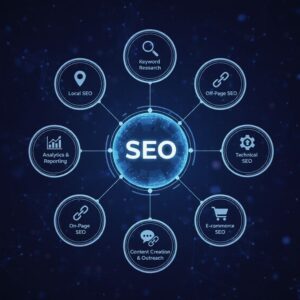
The Core Pillars of SEO
Keyword Research
Keyword research is where every SEO strategy should start. It’s not about stuffing a target phrase into a page — it’s about understanding the exact words your potential customers use, and what they actually want when they type them. Tools like Semrush, Ahrefs, and Google’s own Keyword Planner help uncover both search volume and intent behind a query.
On-Page SEO
This covers everything on the page itself: title tags, meta descriptions, header structure, keyword placement, internal links, and content quality. Good on-page SEO makes it easy for both search engines and readers to understand what a page is about within seconds.
Technical SEO
Site speed, crawlability, indexability, mobile-friendliness, secure connections (HTTPS), and clean site architecture all fall under technical SEO. If a search engine can’t crawl or load your site properly, none of your content matters — this is the foundation everything else sits on.
Off-Page SEO
Primarily backlinks — other credible websites linking to yours. Search engines treat quality backlinks as a vote of confidence. One link from a respected industry publication is worth far more than fifty links from low-quality directories.
Local SEO
Google Business Profile optimization, local citations, location-specific pages, and localized content help businesses show up for “near me” searches and map pack results. For service businesses and local retailers, this pillar often delivers the fastest visible returns.
Content SEO
Publishing content that thoroughly answers a search query — not just touches on it — is what earns rankings today. Thin, generic posts rarely compete against well-researched, genuinely useful content.
Mobile SEO
With most searches now happening on phones, a site that isn’t fast and easy to use on mobile is fighting an uphill battle regardless of how good the content is.
Core Web Vitals
Google’s Core Web Vitals measure real-world loading speed, interactivity, and visual stability. These aren’t vanity metrics — they directly affect both rankings and how long visitors stick around.
Internal Linking
Linking related pages on your own site helps search engines understand your site structure and helps visitors find more of what they need, which in turn improves engagement and time on site.
Structured Data (Schema Markup)
Schema markup helps search engines understand exactly what a page is — a product, an article, an FAQ, a local business — which improves the odds of earning rich results like star ratings, FAQ dropdowns, and breadcrumb trails in search listings.
How AI Is Changing SEO (Not Replacing It)
AI hasn’t killed SEO — it’s changed what “ranking well” means. AI Overviews and generative search results now answer many queries directly on the results page, which has genuinely reduced clicks for certain types of informational searches. That’s real, and businesses should plan for it.
But here’s what AI hasn’t changed: search engines still need to find, understand, and trust content before they can summarize or cite it. AI Overviews pull from sources that are well-structured, clearly written, and demonstrate genuine expertise — which means the fundamentals of good SEO matter more, not less.
A few shifts worth noting for 2026:
- Semantic search and natural language processing mean search engines now understand context and meaning, not just exact-match keywords. Writing naturally for humans tends to perform better than writing for algorithms.
- Entity SEO — helping search engines understand who you are, what you do, and how you relate to other trusted entities — has become a meaningful ranking factor, especially for local and B2B businesses.
- E-E-A-T (Experience, Expertise, Authoritativeness, Trustworthiness) now carries more weight than ever, because AI systems need reliable sources to summarize from, and Google has repeatedly emphasized rewarding content written by people with real, demonstrated experience.
- AI-assisted content creation is common, but content that reads as generic or templated tends to underperform. The businesses winning right now are the ones using AI to speed up research and drafting, then adding real human insight, data, and voice on top.
Common SEO Mistakes That Hurt Rankings
- Keyword stuffing — repeating a phrase unnaturally instead of writing for readers
- Thin content — pages that don’t fully answer the search query
- Duplicate pages — near-identical content competing against itself
- Slow-loading websites — every extra second of load time costs rankings and visitors
- Poor mobile experience — broken layouts or tiny text on phones
- Ignoring search intent — ranking for the wrong reason, then losing the click anyway
- Broken internal links — dead ends that frustrate both users and crawlers
- Missing schema markup — leaving rich result opportunities on the table
- Low-quality backlinks — links from spammy or irrelevant sites can do more harm than good
- Neglecting content updates — letting once-strong pages go stale as competitors improve theirs
15 Proven SEO Best Practices for 2026
- Build content around search intent, not just keywords
- Group related content into topic clusters instead of isolated posts
- Publish long-form, genuinely useful content on your most important topics
- Improve page speed and Core Web Vitals across your site
- Structure content clearly so it’s easy for AI Overviews to reference accurately
- Strengthen internal linking between related pages
- Earn backlinks through genuinely useful content, not link schemes
- Optimize your Google Business Profile and local landing pages
- Add structured data (schema) to key page types
- Track performance regularly with Google Search Console and analytics tools
- Update and refresh older content instead of only publishing new pages
- Write for a specific reader, not a generic audience
- Optimize images with descriptive alt text and compressed file sizes
- Make sure every page has a clear, unique title tag and meta description
- Treat SEO as an ongoing process, not a one-time project
Future of SEO in the AI Era
Looking ahead, a few trends are shaping how search — and SEO — will keep evolving:
- AI-powered and generative search will keep summarizing more queries directly on the results page, especially for broad informational searches.
- Voice search continues to favor conversational, question-based content, since people phrase spoken queries differently than typed ones.
- Visual search is growing as tools let users search using images rather than text, which raises the importance of image optimization.
- Zero-click searches will keep increasing for simple factual queries, which means businesses need to focus SEO efforts on queries where a click still makes sense — comparisons, reviews, service pages, and detailed guides.
- Personalization and first-party data are becoming more central as privacy changes reduce reliance on third-party tracking, making owned channels like SEO and email even more valuable.
Frequently Asked Questions
Is SEO still worth it in 2026?
Yes. Search volume hasn’t dropped — how results are displayed has changed. Businesses that adapt their SEO strategy to AI Overviews, semantic search, and user intent continue to see strong, sustainable returns.
Why is SEO important in digital marketing?
SEO captures people who are already searching for what you offer, which typically makes it one of the highest-intent, most cost-effective channels available compared to interruption-based advertising.
Is SEO better than paid advertising?
It depends on the goal. PPC delivers faster short-term visibility; SEO builds compounding, long-term traffic. Most businesses benefit from using both, weighted according to their timeline and budget.
How long does SEO take to show results?
Most businesses start seeing meaningful movement within 3 to 6 months, with stronger results typically building over 6 to 12 months, depending on competition and starting point.
What is the biggest SEO ranking factor?
There isn’t a single factor — Google’s systems weigh hundreds of signals. That said, relevance to search intent, content quality, and technical accessibility consistently matter the most.
Can AI replace SEO?
No. AI has changed how results are displayed, but search engines still rely on well-structured, trustworthy, crawlable content to generate those results in the first place.
What industries benefit most from SEO?
Nearly all industries benefit, but local service businesses, e-commerce, B2B companies, healthcare, and professional services tend to see especially strong returns due to high-intent search behavior.
How much should businesses invest in SEO?
This varies widely by industry and competition, but SEO should generally be treated as an ongoing monthly investment rather than a one-time project, similar to how you’d budget for any long-term growth channel.
What are the biggest SEO mistakes?
Keyword stuffing, thin content, ignoring technical issues, and treating SEO as a short-term campaign instead of a continuous process are among the most damaging and common mistakes.
How do I start an SEO strategy?
Begin with a technical audit, thorough keyword research aligned to your audience’s intent, and a content plan built around topics your customers actually search for — then build outward from there.
Conclusion
SEO isn’t dead, and it isn’t standing still either. It has simply matured into something that rewards genuine expertise, real usefulness, and technical soundness more than it ever has before. Search remains the place where people go with clear intent — to solve a problem, compare options, or make a decision — and that single fact keeps organic search at the center of digital marketing in 2026.
Businesses that treat SEO as a long-term investment, keep their content genuinely useful, and stay technically sound will keep capturing that high-intent traffic long after a paid campaign has ended. The channel has changed shape. Its value hasn’t.
Looking to increase your online visibility and generate more qualified leads through search? DigiAscend provides data-driven SEO strategies tailored to your business goals. From keyword research and technical SEO to content marketing and local SEO, our experts help you build sustainable organic growth. Contact DigiAscend today for a free SEO consultation and discover how a search-first strategy can drive measurable business success.

Pingback: Best Content Marketing for ranking No.1 google AI overview
Pingback: AI Search Keyword Research in 2026: Right Way vs Wrong Way