Local search has split into two paths. You still need to rank on Google. Now you also need to show up when someone asks ChatGPT, Gemini, or Google’s AI Overview a question about your city or service. That second path is called GEO — Generative Engine Optimization. The tool that helps with both is a content hub
What a Content Hub Is
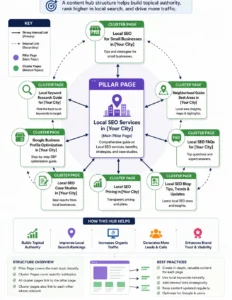
A content hub has three parts:
- A pillar page — one broad, thorough page on your main service and city, like “SEO Services in Delhi.”
- Cluster pages — smaller pages that go deep on one piece of that topic: a neighborhood, an FAQ, a case study, a comparison.
- Internal links — connections between the pillar and its clusters, so search engines see them as one connected body of expertise instead of separate pages.
Why AI Search Changes the Approach
AI tools don’t just match keywords. They look for clear entities — your business, your services, your city — and pull passages that directly answer a question. Content that states facts plainly, in full sentences, and backs them with real experience gets used. Vague, keyword-heavy copy gets skipped.
Building It: The Short Version
- Pick one city or service area to start with, rather than spreading thin across many.
- Research real search intent — what people actually ask, using Google Search, Search Console, and a keyword tool.
- Write the pillar page — comprehensive, local, and honest about what you offer.
- Build 5–8 cluster pages covering FAQs, neighborhoods, case studies, and pricing.
- Link everything together — pillar to cluster, cluster to pillar, related clusters to each other.
- Add schema markup (FAQ, Local Business, Organization, Article) so AI systems can read your content accurately.
- Keep your Google Business Profile current — services, photos, reviews, and Q&A.
- Add real trust signals — author bios, genuine case studies, actual reviews.
- Track results — traffic, rankings, AI mentions, calls, and leads.
What Is a Local SEO Content Hub?
A Local SEO content hub is a group of interconnected pages built around one central topic — usually a service in a specific city — that together tell search engines and AI assistants “we know this subject and this place better than anyone else.”
It’s built on three parts:
A pillar page. This is the anchor. It’s a broad, comprehensive page covering the main topic — for example, “SEO Services in Delhi.” It answers the big questions a reader has and links out to more specific pages.
Cluster pages. These are narrower pages that dig into one piece of the pillar topic in detail — a specific neighborhood, a specific service, a comparison, an FAQ, a case study. Each cluster page links back to the pillar and, where relevant, sideways to other clusters.
Internal linking. The connective tissue. Links from pillar to cluster, cluster to pillar, and cluster to cluster tell search engines how your content fits together. Without this, you just have a pile of disconnected pages.
What Is GEO (Generative Engine Optimization)?
GEO is the practice of optimizing content so that AI-powered search tools — Google AI Overviews, ChatGPT, Gemini, Perplexity, Copilot — can understand it, trust it, and use it to answer questions directly.
Traditional SEO optimizes for rankings. GEO optimizes for citations and mentions inside an AI-generated answer.
To understand why this needs a different approach, it helps to know roughly how these systems work.
Entity-based search. AI search doesn’t just match keywords. It identifies entities — a business, a person, a place, a service — and how they relate to each other. A page that clearly states “DigiAscend is a digital marketing agency based in Varanasi, offering SEO, PPC, and web design” gives an AI model a clean entity to work with. Vague, keyword-heavy copy doesn’t.
Contextual and conversational search. People don’t type “best SEO agency Varanasi” into ChatGPT. They ask, “Which SEO agency in Varanasi actually gets results for small businesses?” Content written to answer full, natural questions performs better in this environment than content written to match short-tail keywords.
Retrieval-Augmented Generation (RAG). Many AI tools work by retrieving relevant chunks of text from the web and using them to construct an answer. This means your content needs to be chunkable — organized into clear sections with direct, self-contained answers — so a retrieval system can pull out a useful passage without needing the rest of the page for context.
In practice, GEO and traditional SEO overlap far more than they compete. Clear structure, direct answers, credible sourcing, and genuine expertise help you rank on Google and get cited by AI tools at the same time. A content hub, built correctly, does both.
Why Traditional Location Pages No Longer Win
Most local businesses already have city or location pages. Most of them aren’t working anymore, for a few consistent reasons.
Thin pages. A page that says “We offer SEO services in Kanpur, Lucknow, and Varanasi” with 150 words and a contact form gives search engines nothing to work with. There’s no depth, no evidence of expertise, nothing an AI system could cite.
Duplicate city pages. Swapping the city name into an otherwise identical template is one of the fastest ways to get pages ignored or filtered out of the index. Google’s systems are good at detecting near-duplicate content, even across different URLs.
Keyword stuffing. Repeating “SEO services in Varanasi” eight times in three paragraphs doesn’t help anymore. It reads badly to a human, and modern search systems weight natural language far more heavily than keyword frequency.
No topical authority. A single, isolated location page with no supporting content behind it looks thin to a search engine, no matter how well it’s written. Authority comes from a body of related content, not one page trying to do everything.
Weak internal linking. Pages that aren’t linked to anything else on the site are hard for search engines to understand in context, and hard for users to discover through browsing.
The fix isn’t a better single page. It’s a structure — a hub — where depth and authority build up across many connected pages instead of resting on one.
How to Build a Local SEO and GEO Content Hub
Step 1: Choose Your City
Start with the city or service area that matters most to your business right now. If you’re a single-location business, this is straightforward — it’s wherever you operate. If you serve multiple cities, pick the one with the strongest existing demand or the best growth opportunity, and build your first hub there before expanding.
Trying to build hubs for ten cities at once usually means none of them get finished properly. One strong hub beats five thin ones.
Step 2: Research Local Search Intent
Before writing anything, understand what people in that city are actually searching for, and what kind of answer they want.
Break keywords into four intent types:
- Informational — “how does local SEO work,” “what does a digital marketing agency do”
- Commercial — “best digital marketing agency in Varanasi,” “top-rated SEO company near me”
- Transactional — “hire SEO agency Varanasi,” “digital marketing packages pricing”
- Conversational — “which agency in Varanasi is good for small business SEO,” the kind of phrasing people use with AI assistants
Useful tools for this stage: Google Search itself (look at “People also ask” and related searches), Google Trends for seasonal patterns, Google Search Console if you already have traffic data, Google Keyword Planner, Ahrefs, and Semrush for volume and competition data.
Step 3: Create Pillar Pages
Your pillar page should be the most comprehensive page on your site for that topic and city. Think “SEO Services in Delhi,” “Digital Marketing in Lucknow,” or “Home Renovation in Jaipur” — broad enough to cover the whole service, specific enough to be clearly local.
A strong pillar page includes:
- A clear explanation of the service and who it’s for
- Local context — neighborhoods served, local market knowledge, local case examples
- Links to every cluster page under it
- Trust signals — credentials, reviews, results
Step 4: Create Cluster Content
This is where most of the depth gets built. Useful cluster formats include:
- Neighborhood or area-specific pages
- Individual service pages
- FAQ pages
- Comparison articles (“Agency A vs. Agency B”)
- Case studies
- Location guides
- Pricing pages
- Industry-specific pages (e.g., “SEO for Healthcare Businesses in Varanasi”)
- Problem-solving articles (“Why Isn’t My Business Showing on Google Maps?”)
- Checklist articles
- How-to blogs
- Statistics pages
- Trend articles
You don’t need all of these on day one. Start with five to eight clusters that answer your most common customer questions, then expand.
Step 5: Build Internal Linking
This is the step that turns a pile of pages into a hub.
- Hub → Cluster: Every pillar page should link to its full set of cluster pages, usually in a clearly labeled section like “Related Guides” or “Explore This Topic.”
- Cluster → Hub: Every cluster page should link back up to the pillar, so search engines understand the hierarchy.
- Related clusters: Cluster pages should link sideways to each other where the content genuinely connects — a neighborhood page linking to a relevant case study, for instance.
- Entity linking: Link mentions of your business name, service names, and location names consistently, so search engines can connect them across pages.
- Contextual links: Place links inside the body text where they add value, not just in a footer list.
Step 6: Optimize for AI Search
This is where GEO-specific work comes in.
- Entity optimization: State clearly, in plain language, who you are, what you do, and where you operate. Don’t make an AI system guess.
- Schema markup: Structured data helps search engines and AI crawlers parse your content accurately. Priority types for a local content hub: FAQ schema, Organization schema, LocalBusiness schema, Breadcrumb schema, and Article schema. (Full recommendations are in the schema section below.)
Step 7: Optimize Your Google Business Profile
Your content hub and your Google Business Profile should reinforce each other. Keep these current:
- Services list, matching the services described on your pillar and cluster pages
- Photos — real ones, updated regularly
- Posts — tied to blog content or offers
- Reviews — actively requested and responded to
- Q&A section, seeded with real customer questions
- Products, if applicable
- Categories, kept accurate and specific
Step 8: Add Trust Signals
E-E-A-T (Experience, Expertise, Authoritativeness, Trustworthiness) isn’t a checkbox. It shows up in specifics:
- Author bios with real names and real credentials
- First-hand experience — what you’ve actually seen work and not work
- Case studies with real (or clearly realistic, if illustrative) numbers
- Client reviews, quoted with attribution
- Statistics, sourced properly
- Expert quotes
- Clear sourcing for any claim that isn’t your own direct experience
Step 9: Create Supporting Assets
Text-only hubs work, but multi-format hubs perform better, especially for AI search, which increasingly draws on images, video transcripts, and structured data.
- Infographics summarizing key data
- Short videos — even simple ones — with transcripts
- Embedded maps for location pages
- Original photos, not stock images, wherever possible
- Checklists readers can save or print
- Simple calculators (pricing estimators, ROI calculators)
- Downloadable templates
Step 10: Measure Performance
Track these consistently:
- Organic traffic to hub pages
- Local ranking positions
- Mentions or citations in AI-generated answers (check manually by asking relevant questions in ChatGPT, Gemini, and Perplexity)
- Featured snippet appearances
- AI Overview appearances
- Click-through rate
- Conversions — form fills, calls, direction requests
- Leads generated
- Revenue attributable to the hub, where trackable
Common Mistakes to Avoid
- Duplicate pages — swapping only the city name across identical templates
- AI-generated spam — publishing unedited AI output with no human review or local knowledge added
- No internal links — pages that exist in isolation
- No FAQs — missing an easy, high-value opportunity for both SEO and GEO
- Poor schema implementation — missing, incorrect, or incomplete structured data
- Weak heading hierarchy — skipping from H1 straight to H4, or using headings that don’t describe the content
- Thin content — pages under 300–400 words trying to compete for competitive local terms
- No topical authority — one strong page with nothing supporting it
- Ignoring entities — never clearly stating who you are, what you do, or where you’re based
- Poor UX — slow load times, intrusive pop-ups, hard-to-read fonts
- No local proof — no reviews, no local case studies, no real addresses or service areas listed
- Inconsistent NAP data — business Name, Address, and Phone number that don’t match across your site, Google Business Profile, and directories
- Ignoring mobile experience — most local searches happen on a phone
- No update cadence — publishing a hub once and never revisiting it as services, pricing, or the local market changes
- Chasing rankings only — optimizing purely for keyword position while ignoring whether the content actually answers the reader’s question
- No clear CTAs — strong content that never tells the reader what to do next
- Overlooking AI search entirely — building only for traditional Google rankings while AI-driven discovery keeps growing
Case Study: How One Local Business Built a Content Hub
To illustrate the process end to end, here’s a representative example based on the kind of results this approach typically produces. (Business name and exact figures below are illustrative, built from patterns we’ve seen across real local SEO campaigns.)
The business: A mid-sized home renovation company serving Jaipur, with one physical showroom and a small existing website.
The starting point: Three thin location pages, no blog, no schema markup, inconsistent Google Business Profile listings, and almost no presence in AI-generated answers when asked about renovation companies in the city.
The approach:
- Built one pillar page: “Home Renovation Services in Jaipur”
- Added eight cluster pages over three months: kitchen renovation, bathroom renovation, budget planning, a neighborhood guide, an FAQ page, two case studies, and a pricing guide
- Implemented LocalBusiness, FAQ, and Article schema across the hub
- Rebuilt internal linking so every cluster connected to the pillar and to at least one related cluster
- Fully optimized the Google Business Profile — services list, weekly photo updates, and a consistent review request process
The results over six months:
- Organic traffic to the hub grew from roughly 200 to over 2,400 monthly visits
- Local map pack rankings for core renovation terms moved from page two to the top three positions
- The business began appearing in AI Overview answers for several “renovation company near me”-style queries
- Inbound calls attributed to the website increased by roughly 3x
- Direction requests from Google Business Profile more than doubled
The pattern behind these numbers is consistent: growth came from depth and structure building up over months, not from any single page or single change.
Frequently Asked Questions
What is a Local SEO Content Hub?
It’s a structured group of connected pages — a pillar page plus supporting cluster pages — built around a specific service and city, designed to build topical authority and rank well both in traditional search and AI-generated answers.
Does every local business need one?
If you rely on local search for customers, yes, in some form. The scale can vary. A single-location business needs a smaller hub than a multi-location chain, but the structure — pillar plus clusters plus internal linking — helps at any size.
Is GEO replacing SEO?
No. GEO builds on SEO fundamentals rather than replacing them. Clear structure, genuine expertise, and good internal linking help you rank on Google and get cited by AI tools at the same time.
How many location pages should I create?
Enough to genuinely cover your real service areas, no more. One well-developed page per city or region beats ten thin ones covering areas you barely serve.
Can AI-generated content rank?
Unedited AI content, published as-is, generally performs poorly and risks being flagged as low-quality. AI-assisted content that’s edited, fact-checked, and enriched with real local knowledge and experience can perform well.
How do AI Overviews affect local SEO?
They often answer a query directly at the top of the results page, which can reduce clicks for lower-ranking results. Being clearly structured and well-sourced increases your odds of being the source an AI Overview cites or pulls from.
How long does it take to see results?
Most local content hubs start showing measurable movement in three to six months, with stronger results building over six to twelve months as the hub matures.
What’s the difference between a pillar page and a landing page?
A landing page is typically built for a single campaign or conversion goal. A pillar page is a comprehensive, evergreen resource meant to anchor a whole cluster of related content and attract organic search traffic over time.
How can I optimize for ChatGPT and Google AI Overviews?
Write clear, self-contained answers to real questions, state facts plainly, back claims with sources or experience, and use structured data so machines can parse your content accurately.
Do I need schema markup for local SEO?
It’s not strictly required to rank, but it significantly improves how accurately search engines and AI systems understand your content, and it’s one of the more reliable ways to earn rich results.
Should every page target a different keyword?
Roughly, yes — overlapping keywords across pages on the same site can cause them to compete with each other instead of Google choosing the best match.
What’s the ideal word count for a pillar page?
There’s no fixed number, but pillar pages for competitive local terms typically run 1,500–3,000+ words when they genuinely cover the topic in depth, not padded for length.
How often should I update a content hub?
Review core pages at least twice a year, and add new cluster content on an ongoing basis as new customer questions or services come up.
Does my Google Business Profile affect my content hub’s performance?
Yes. They work together — a well-optimized profile drives local visibility, and a strong content hub gives you material to link to and share from the profile.
Can a small business realistically compete with bigger companies using this approach?
Yes, often better than in traditional SEO, because a smaller business can build genuine local depth and specific expertise faster than a larger company managing dozens of markets at once.
What tools do I need to get started?
At minimum: Google Search Console, Google Business Profile, and a keyword research tool like Google Keyword Planner. Ahrefs or Semrush help at scale but aren’t required to start.
Should I hire an agency or build this myself? Either can work. What matters is having the time and skill to research intent properly, write genuinely useful content, and maintain the technical pieces like schema and internal linking consistently over time.
Conclusion
Local search isn’t disappearing, but the path to being found has split in two. You still need to rank in traditional Google results, and now you also need to be the kind of clear, well-sourced, well-structured content that AI systems choose to cite.
A Local SEO and GEO Content Hub is how you do both at once. Pillar pages give you depth. Cluster pages let you cover the full range of what your customers actually ask. Internal linking ties it all together into something search engines and AI systems both recognize as genuine authority, not a pile of disconnected pages.
None of this happens overnight. The businesses that see the strongest results are the ones that build steadily — a pillar page, a handful of solid clusters, real internal linking, real trust signals — and keep adding to it over months, not weeks.
If you’re not sure where to start, that’s normal. Mapping out the right pillar and cluster structure for your specific city and services is the part most businesses get stuck on. DigiAscend offers a free local SEO audit to help you see exactly where your current content stands and what a hub built for your business would look like. Reach out, and let’s map it out together.
Also read– Local SEO Checklist for 2026: 50 Tasks to Win AI Overviews and Voice Search