
Search “best plumber near me” today, and odds are you won’t even click a link. Google’s AI will just answer it for you at the top of the page.
That’s a big deal. Ranking on page one used to guarantee traffic. Now it can just mean Google’s AI read your content, summed it up, and sent people on their way without a visit to your site.
So the question every business owner is asking makes sense: is traditional SEO still worth it, or has AI made it pointless? Truth is, it’s neither. AI SEO and traditional SEO aren’t competing strategies — the real question is how to make them work together so your business stays visible.
That’s what this guide covers: the real differences between the two, why leaning on just one leaves gaps, and how to build a strategy that works no matter how someone finds you — Google search, an AI Overview, or a ChatGPT conversation.
What Is Traditional SEO?
Traditional SEO is the practice of optimizing a website so Google’s crawlers can find it, understand it, and rank it for relevant searches. It’s built on three pillars that have stayed roughly the same since the early 2000s.
On-page SEO covers what’s inside your website: title tags, headers, keyword placement, internal links, and content quality. Off-page SEO covers what happens outside your site, mainly backlinks from other websites vouching for yours. Technical SEO covers whether your site actually works — page speed, mobile-friendliness, crawlability, and clean site architecture.
Advantages of traditional SEO:
- It’s measurable. Rankings, traffic, and backlinks are easy to track.
- It builds long-term equity. A well-optimized page can rank for years.
- It’s fundamental. AI search still depends on crawlable, well-structured websites to pull information from.
Limitations of traditional SEO:
- It assumes a searcher will click through to a website to get their answer. That assumption is breaking down.
- It’s slower to reflect how people actually phrase questions when talking to an AI assistant instead of typing keywords into a search box.
- Traditional keyword density and backlink-counting logic doesn’t map cleanly onto how large language models decide what to cite.
Traditional SEO isn’t dead. But treating it as the whole strategy in 2026 is like optimizing a store only for people who walk in the front door, while ignoring the growing number of customers who ask a smart assistant to describe the store for them.
What Is AI SEO?
AI SEO — sometimes called Generative Engine Optimization (GEO) or Answer Engine Optimization (AEO) — is the practice of optimizing content so AI-powered search systems can understand it, trust it, and use it to generate answers or citations.
This covers a wider set of surfaces than a traditional Google results page:
- Google AI Overviews — AI-generated summaries that appear above traditional search results
- ChatGPT Search — conversational search built directly into ChatGPT
- Bing Copilot — Microsoft’s AI assistant layered over Bing search
- Perplexity AI — an answer engine that cites sources directly in its responses
- Voice search — spoken queries through smart speakers and voice assistants, which tend to be longer and more conversational than typed searches
These systems don’t rank ten blue links. They read across many sources, synthesize an answer, and decide which sources (if any) are worth citing. That changes what “optimization” means. Instead of asking “how do I rank #1 for this keyword,” AI SEO asks how do I become the source an AI system trusts enough to quote or cite.”
That shift rewards content that’s clearly structured, factually precise, and easy for a language model to extract and summarize — think direct answers near the top of a section, clean formatting, and content that reads like it was written by someone with real, specific experience rather than someone padding a word count.
AI SEO vs Traditional SEO: The Full Comparison
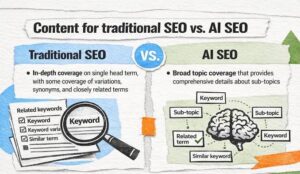
| Factor | Traditional SEO | AI SEO |
| Primary goal | Rank in the top 10 search results | Get cited or summarized in AI-generated answers |
| Ranking factors | Keywords, backlinks, page speed, technical health | Entity clarity, semantic relevance, factual accuracy, structured data |
| Search intent | Matched via keyword and query mapping | Matched via natural language understanding and context |
| Keywords | Exact-match and close-variant keywords | Concepts, entities, and question phrasing |
| Content strategy | Keyword-targeted pages and blog posts | Comprehensive, well-structured answers to real questions |
| Link building | Backlinks as the main trust signal | Brand mentions, citations, and digital PR across the web |
| User experience | Page speed, mobile usability, navigation | Same, plus how easily an AI model can parse the content |
| Technical SEO | Crawlability, sitemaps, indexing | Crawlability plus clean, machine-readable content structure |
| Structured data | Optional, used for rich snippets | Increasingly essential for AI systems to understand context |
| Entity optimization | Minimal historical focus | Central — Google’s Knowledge Graph and AI models reason in entities |
| Semantic search | Emerging focus over the last decade | Core requirement |
| AI citations | Not applicable | A primary success metric |
| E-E-A-T | Important ranking consideration | Even more critical — AI systems weigh trust signals heavily when choosing what to cite |
| Zero-click searches | Seen as a traffic loss | Treated as a visibility and brand-awareness opportunity |
| Local SEO | Google Business Profile, citations, reviews | Same, plus AI-generated local answers pulling from the same signals |
| Analytics | Clicks, rankings, sessions | Clicks and rankings, plus citation tracking and brand mention monitoring |
| Future readiness | Necessary but insufficient alone | Necessary but built on top of traditional SEO fundamentals |
The takeaway: these aren’t two separate playbooks. AI SEO is largely traditional SEO’s fundamentals, extended and re-weighted for a world where the “reader” is sometimes a language model instead of a person.
Why Traditional SEO Alone Isn’t Enough in 2026
A few years ago, ranking #1 on Google almost guaranteed a click. That’s no longer a safe bet.
AI Overviews are eating clicks. When Google can answer a query directly at the top of the page, a meaningful share of searchers never scroll down to the organic results at all — even the #1 result.
Zero-click searches are the new normal. Weather, definitions, conversions, quick facts, and increasingly, comparison-style questions get answered directly on the results page. If your content strategy only accounts for clicks, you’re measuring a shrinking slice of your actual visibility.
Search is becoming entity-based, not just keyword-based. Google doesn’t just match strings of text anymore. It understands “DigiAscend” as a specific entity — a digital marketing agency, located in a specific city, offering specific services — and connects that entity to related concepts. Keyword-stuffed pages that ignore this context struggle to compete.
Conversational and voice search change query patterns. “SEO agency Varanasi” and “which SEO agency in Varanasi actually gets results for small businesses” are different queries with different intent signals, and traditional keyword targeting handles the second one poorly.
Personalization is deeper than it used to be. Search results — and AI answers — increasingly reflect a searcher’s location, history, and context. A one-size-fits-all optimized page has less room to compete.
Why AI SEO Matters
AI SEO matters because it’s how you earn visibility in the growing number of situations where a person never scrolls past an AI-generated answer.
Entity optimization helps search engines and AI models understand exactly what your business is, what it does, and where it operates — not just what keywords appear on your pages.
Semantic search and context mean content gets evaluated on meaning, not just keyword matches. A page that thoroughly answers a question in plain language often outperforms a page stuffed with exact-match phrases.
The Knowledge Graph is Google’s structured database of entities and how they relate to each other. Getting your business, your team, and your expertise represented accurately here supports both traditional rankings and AI citations.
AI citations are becoming a visibility metric in their own right. Being the source- ChatGPT or Perplexity quotes when answering a question in your industry builds brand awareness even without a click.
NLP (natural language processing) is how AI systems parse your content’s meaning. Writing in clear, direct language — the way a knowledgeable person would actually explain something — tends to perform better than dense, jargon-heavy copy optimized purely for keyword density.
Structured data (schema markup) gives search engines and AI systems explicit, machine-readable context about your content: what type of page it is, what questions it answers, what business is behind it.
Helpful content and topical authority reward businesses that publish genuinely useful information across a topic, not just isolated keyword-targeted posts. Depth and consistency signal expertise.
Brand mentions and digital PR — even unlinked mentions of your business name — are increasingly treated as trust and relevance signals, since AI systems weigh how often and how positively a source is discussed across the web.
AI SEO + Traditional SEO = Winning Strategy
The businesses winning in 2026 aren’t choosing between traditional SEO and AI SEO. They’re layering AI SEO on top of a solid traditional foundation.
| Traditional SEO Foundation | AI SEO Layer | Combined Outcome |
| Technical SEO (speed, crawlability, mobile) | Clean, machine-readable content structure | Content that both ranks and gets parsed accurately by AI systems |
| Keyword-targeted pages | Entity and topic clustering around those keywords | Broader topical authority, not just isolated rankings |
| Backlinks | Brand mentions, digital PR, citations | Trust signals across both link-based and mention-based systems |
| On-page optimization | Structured data (schema) | Higher chance of appearing in rich results and AI citations |
| Local SEO listings | AI-optimized local content (FAQs, entity clarity) | Visibility in both map packs and AI-generated local answers |
| Content quality | E-E-A-T signals (author credentials, real experience) | Content AI systems are more willing to cite as a trustworthy source |
| Page speed and UX | Content structured for extractability | Better rankings and higher odds of being the quoted source |
Step-by-Step AI SEO Strategy for 2026
Step 1: Keyword Research, Expanded for AI Search Start with traditional keyword research, but add question-based and conversational variants. Tools that show “People Also Ask” data and AI Overview trigger queries are worth the extra look.
Step 2: Search Intent Mapping Group keywords by what the searcher actually wants — informational, navigational, commercial, or transactional — and match content format accordingly. A comparison query deserves a comparison table, not a sales pitch.
Step 3: Topical Authority Build content clusters instead of isolated posts. A pillar page on “SEO strategy” supported by cluster content on schema, local SEO, and technical SEO signals depth that a single standalone article can’t.
Step 4: Entity SEO Make sure your business, your services, and your key people are clearly and consistently represented — on your website, your Google Business Profile, and across the web. Consistency in how your business is described helps AI systems build an accurate picture.
Step 5: Schema Markup Implement structured data for articles, FAQs, local business information, and breadcrumbs. This gives search engines and AI systems explicit context they don’t have to guess at.
Step 6: Internal Linking Link related content together using descriptive anchor text. This helps both traditional crawlers and AI systems understand how your content connects.
Step 7: Helpful, Extractable Content Write content that answers questions directly and early, backed by real expertise. Avoid padding — AI systems and human readers both skip past filler.
Step 8: AI Citation Optimization Structure key facts, statistics, and definitions as clear, standalone statements that could be lifted and cited on their own. Ask yourself: could an AI system quote this sentence without needing three paragraphs of context?
Step 9: Local SEO Keep your Google Business Profile complete and accurate, gather genuine reviews, and publish locally relevant content. Local AI answers draw heavily on the same signals as the local map pack.
Step 10: Continuous Monitoring Track not just rankings and clicks, but also brand mentions and, where tools allow, whether your content is being cited in AI answers. This space moves fast — monthly review beats quarterly review.
Common Mistakes Businesses Make while doing SEO/AI SEO
- Ignoring technical SEO because “AI SEO is different.” AI systems still rely on crawlable, fast, well-structured sites. Skipping the basics undermines everything built on top.
- Keyword stuffing content meant for AI citation. Unnatural repetition reads poorly to both AI parsers and human readers. Write for clarity first.
- Treating AI Overviews as pure traffic loss. Some queries were never going to convert to clicks anyway. Focus energy on the queries where visibility still drives real business outcomes.
- Skipping schema markup entirely. It’s one of the lowest-effort, highest-context signals available, and plenty of businesses still haven’t implemented it.
- Publishing thin, single-purpose keyword pages. Depth and topical clusters outperform isolated, shallow pages in both traditional and AI search.
- No clear author or business identity on content. Anonymous or vague authorship weakens E-E-A-T, which matters more, not less, for AI citation.
- Inconsistent business information across the web. Mismatched name, address, or service descriptions confuse entity recognition.
- Forgetting local intent. Local businesses that ignore local SEO basics lose visibility in both the map pack and local AI answers.
- Chasing every AI SEO trend without a content foundation. GEO tactics layered on thin, low-quality content rarely stick.
- No internal linking strategy. Isolated pages make it harder for both crawlers and AI systems to understand topical relationships.
- Ignoring page speed and mobile experience. Still a ranking factor, and still a common reason otherwise strong content underperforms.
- Writing for algorithms instead of people. Content that reads like it was written for a machine tends to perform worse with both machines and people — AI systems increasingly favor genuinely useful writing.
- Not tracking brand mentions. Businesses that only monitor rankings miss a growing part of the visibility picture.
Real-World Example: How One Local Business Adapted AI SEO
Consider a mid-sized home services business that had relied on traditional SEO for years: solid on-page optimization, a handful of backlinks, decent rankings for a dozen core keywords.
Over several months, their team noticed something: rankings stayed roughly stable, but organic traffic slipped. The reason was AI Overviews increasingly answering their target queries directly, without sending clicks to any website.
Their response combined both approaches. They kept every technical SEO fundamental in place, then layered in an AI SEO push: FAQ schema on service pages, clearer entity information across their website and directory listings, more direct, extractable answers near the top of key pages, and consistent publishing around a small set of topic clusters instead of scattered one-off posts.
In the following quarter, hypothetically, their organic clicks partially recovered, and — more notably — they began showing up as a cited source in AI-generated answers for several of their core service queries, something they had no visibility into before they started tracking brand mentions alongside rankings.
The lesson isn’t a guaranteed formula. It’s that businesses actively adapting to both search layers tend to recover ground that AI Overviews are otherwise taking from static, traditional-only strategies.
Myth vs Fact About AI SEO
Myth: Traditional SEO is dead. Fact: Traditional SEO fundamentals — technical health, quality content, backlinks — remain the foundation AI search is built on.
Myth: AI SEO means writing for robots, not people. Fact: AI systems increasingly reward genuinely helpful, well-structured content written for real readers.
Myth: Zero-click searches mean zero value. Fact: Brand visibility and AI citations still build awareness and trust, even without a click.
Myth: You need to abandon keywords entirely for AI SEO. Fact: Keywords still matter — they’re just expanding to include entities, concepts, and natural-language questions.
Mini Glossary
- GEO (Generative Engine Optimization): Optimizing content to be understood and used by generative AI systems like ChatGPT and Google AI Overviews.
- AEO (Answer Engine Optimization): Optimizing content specifically to be selected as a direct answer by answer-focused search tools.
- Semantic SEO: Optimizing for meaning and context rather than exact keyword matches.
- Entities: Specific, distinct things — a business, person, place, or concept — that search engines track and connect through the Knowledge Graph.
- AI citations: Instances where an AI system references or quotes a specific source in its generated answer.
- Zero-click searches: Searches where the user’s need is met directly on the results page, without a click to any website.
The Future of SEO Beyond 2026
A few trends are likely to keep shaping SEO in the coming years:
- AI agents that don’t just answer questions but complete tasks — booking appointments or comparing options — on a user’s behalf, pulling from structured business data to do it.
- Conversational and predictive search, where systems anticipate follow-up questions and shape multi-turn interactions instead of single queries.
- Multimodal search, blending text, voice, and image input into a single search session.
- Personalized AI assistants that carry context across sessions, making generic, one-size-fits-all content less competitive.
- Visual search, where image-based queries drive discovery, especially in retail and local services.
- Voice-first experiences continuing to grow as smart speakers and in-car assistants become more capable.
- AI-driven SERPs that blend traditional results, AI summaries, and interactive elements into a single, more dynamic page.
Businesses that keep their technical and content foundations strong, while staying genuinely useful and well-structured for AI systems, are the ones best positioned for whatever comes next.
Frequently Asked Questions
Is AI SEO replacing traditional SEO?
No. AI SEO builds on traditional SEO fundamentals rather than replacing them. Technical health, quality content, and backlinks still matter — AI SEO adds a layer focused on how AI systems parse, trust, and cite that content.
What is the biggest SEO trend in 2026?
The growth of AI Overviews and zero-click search is the defining trend. Businesses are adjusting content strategy to earn visibility and citations even when searchers don’t click through to a website.
Can AI do SEO better than humans?
AI tools speed up research, drafting, and analysis, but human judgment still matters for strategy, genuine expertise, and writing content that reflects real experience — a core part of what E-E-A-T rewards.
How do I optimize for AI Overviews?
Write clear, direct answers early in your content, use structured data, and make sure your business and expertise are consistently represented across the web. AI Overviews favor content that’s easy to extract and trustworthy.
What is GEO in SEO?
GEO, or Generative Engine Optimization, is the practice of optimizing content so generative AI tools like ChatGPT and Google AI Overviews can understand it and use it in their generated answers.
What is Answer Engine Optimization (AEO)?
AEO is optimizing content specifically to be selected as a direct, standalone answer by answer-focused tools like voice assistants and AI search engines, rather than just ranking as a link.
Should small businesses invest in AI SEO?
Yes, alongside traditional SEO. Small and local businesses are especially affected by AI Overviews answering local queries directly, so building strong entity signals and structured data helps maintain visibility.
Does AI SEO require different keywords than traditional SEO?
Not entirely different — more expanded. AI SEO adds conversational, question-based, and entity-focused terms on top of traditional keyword targeting.
What is a zero-click search, and should I worry about it?
A zero-click search is one where the user’s question gets answered directly on the results page. It’s worth tracking, but not something to panic over — focus on visibility and citations for queries where it happens, rather than treating it as pure lost traffic.
How long does it take to see results from AI SEO?
Similar to traditional SEO — meaningful results typically take a few months, since it depends on how quickly search engines and AI systems re-crawl and re-evaluate your content and entity signals.
Do I need schema markup for AI SEO to work?
It’s not strictly required, but it significantly helps. Schema gives search engines and AI systems explicit context about your content, which supports both rich results and AI citations.
Is voice search part of AI SEO?
Yes. Voice search queries tend to be longer and more conversational, and optimizing for them overlaps heavily with optimizing for AI Overviews and answer engines.
Can traditional SEO tactics hurt my AI SEO performance?
Outdated tactics like keyword stuffing or thin content can hurt both. Solid traditional SEO — genuine quality, clear structure, technical health — supports AI SEO rather than conflicting with it.
What’s the difference between E-E-A-T and AI SEO?
E-E-A-T (Experience, Expertise, Authoritativeness, Trustworthiness) is a quality framework Google uses across all search, including AI Overviews. It’s not separate from AI SEO — strong E-E-A-T signals directly support AI citation and trust.
Conclusion
If your current SEO strategy hasn’t adapted to AI Overviews, ChatGPT Search, and the other shifts covered in this guide, now’s the time to look under the hood. Digiascend provided digital marketing services to help your business grow online. Request a free SEO audit and we’ll show you exactly where your site stands — and what it would take to compete in both traditional and AI-powered search.
Also Read-
How to Build a Local SEO and GEO Content Hub for Your City
Zero-Click and AI Results: How to Still Generate Leads When Nobody Clicks
Local SEO Checklist for 2026: 50 Tasks to Win AI Overviews and Voice Search

Pingback: AI Search Keyword Research in 2026: Right Way vs Wrong Way
Pingback: AI-assisted Content Briefs: 10 ways to Protect E-E-A-T